
Cotton vs. Polyester T-Shirts: Which Fabric Should You Choose?
Choosing the right fabric is one of the most important decisions when developing custom T-shirts for your clothing brand, business, or promotional project.
Among the most commonly used materials, cotton and polyester offer different characteristics in terms of comfort, breathability, moisture management, durability, appearance, and printing compatibility.
So, when comparing cotton vs polyester T-shirts, which fabric should you choose?
The answer depends on your target customers, product positioning, intended use, and manufacturing requirements. Cotton is often preferred for everyday casualwear, while polyester is widely used in sportswear and performance apparel. Blended fabrics can also provide a balance of different properties.
In this guide, we compare cotton and polyester T-shirt fabrics to help clothing brands, wholesalers, and B2B buyers select the right material for their custom apparel projects.

1. What Is the Difference Between Cotton and Polyester T-Shirts?
Cotton and polyester are two different textile fibers with distinct characteristics.
Cotton T-Shirts
Cotton is a natural fiber obtained from the cotton plant. It is widely used in casual clothing because of its familiar soft hand feel and comfort.
Cotton T-shirts are commonly selected for:
Everyday casualwear
Corporate and promotional T-shirts
Basic clothing collections
Private-label apparel
Retail and wholesale T-shirt products
Depending on the yarn, knitting structure, and finishing process, cotton fabrics can offer different levels of softness, thickness, texture, and appearance.
Polyester T-Shirts
Polyester is a synthetic fiber commonly used in sportswear, activewear, and performance-oriented clothing.
Polyester fabrics can be engineered to provide useful properties such as moisture management, quick drying, dimensional stability, and color retention.
Polyester T-shirts are commonly considered for:
Sports and fitness apparel
Team jerseys
Running and training shirts
Promotional sportswear
Performance clothing collections
The actual performance of polyester depends on yarn characteristics, fabric construction, finishing, and garment design.
2. Cotton vs. Polyester T-Shirts: Key Differences
Before selecting a material for your custom T-shirt project, it is useful to compare their general characteristics.
| Feature | Cotton T-Shirts | Polyester T-Shirts |
|---|---|---|
| Fiber type | Natural fiber | Synthetic fiber |
| Hand feel | Often soft and natural | Depends on yarn and construction |
| Moisture behavior | Absorbs moisture | Generally absorbs less moisture into the fiber |
| Drying | Often dries more slowly | Often dries faster |
| Breathability | Depends on fabric construction | Depends on fabric construction |
| Durability | Depends on fiber quality and construction | Often offers good dimensional stability |
| Shrinkage | Can shrink if not properly processed | Generally more dimensionally stable |
| Wrinkle resistance | Can wrinkle more easily | Often more wrinkle resistant |
| Printing | Suitable for many printing methods | Requires attention to ink and process compatibility |
| Common applications | Casualwear and promotional clothing | Sportswear and performance apparel |
These are general comparisons, not guarantees for every fabric. Fabric construction, fiber quality, dyeing, finishing, and garment care can significantly influence the final result.
3. Cotton T-Shirts: Advantages and Limitations
Cotton remains a popular choice for everyday T-shirts and casual clothing collections.
Advantages of Cotton T-Shirts
1. Comfortable Hand Feel
Cotton fabrics are often valued for their soft and familiar feel against the skin.
The final hand feel depends on cotton quality, yarn spinning, knitting structure, and finishing treatments.
2. Suitable for Everyday Clothing
Cotton T-shirts are widely used for daily wear, corporate uniforms, promotional products, and basic apparel collections.
They can be developed in different weights, fits, and garment styles.
3. Versatile Printing Options
Cotton fabrics are compatible with many common garment printing techniques.
Screen printing is frequently used for cotton T-shirts. DTG printing is also commonly associated with cotton garments, while DTF transfers may be applied to compatible cotton fabrics.
The best printing method depends on the design, fabric color, surface characteristics, and production requirements.
4. Wide Range of Fabric Options
Cotton T-shirts can be developed using different yarn types, knitting structures, and fabric weights.
This gives clothing brands flexibility when developing lightweight basics, midweight everyday T-shirts, or heavyweight streetwear products.
Limitations of Cotton T-Shirts
1. Moisture Absorption
Cotton absorbs moisture into its fibers. This can make cotton garments feel damp during intense physical activity or in humid conditions.
2. Potential Shrinkage
Cotton fabrics may shrink during washing and drying. Proper fabric processing, garment construction, and shrinkage testing are important before bulk production.
3. Wrinkling
Cotton garments can wrinkle more easily than many polyester garments and may require additional care.
4. Drying Time
Because cotton absorbs moisture, it can take longer to dry than comparable polyester fabrics under similar conditions.
4. Polyester T-Shirts: Advantages and Limitations
Polyester is widely used in performance apparel because of its versatility and ability to be engineered for different functional requirements.
Advantages of Polyester T-Shirts
1. Moisture Management Potential
Polyester fibers absorb relatively little moisture into the fiber itself.
With suitable fabric construction and finishing, polyester garments can help move moisture across the fabric surface and support faster evaporation.
This makes polyester a common choice for sportswear and training apparel.
2. Quick-Drying Performance
Polyester T-shirts generally dry faster than comparable cotton garments because the fiber retains less moisture.
This can be useful for running shirts, sports jerseys, and activewear.
3. Dimensional Stability
Polyester fabrics often offer good dimensional stability and resistance to shrinkage when properly manufactured and cared for.
4. Wrinkle Resistance
Polyester is generally more wrinkle resistant than cotton, which can make it convenient for certain uniforms and sportswear applications.
5. Suitable for Sublimation Printing
Polyester is widely used for sublimation printing.
When compatible polyester fabrics and sublimation dyes are used, the design can be transferred into the fiber through a heat-based process.
This technique is commonly used for custom sports jerseys, teamwear, and all-over printed apparel.
Limitations of Polyester T-Shirts
1. Different Hand Feel
Some polyester fabrics may feel smoother or more synthetic than cotton. However, modern yarns and fabric constructions can create a wide range of textures and hand feels.
2. Heat Sensitivity During Printing
Polyester can be sensitive to high temperatures during printing and heat-transfer applications.
The correct temperature, pressing time, transfer materials, and production conditions must be carefully controlled.
3. Odor Management Depends on Fabric Design
Polyester can retain certain body odors, particularly when oils and residues accumulate in the fabric.
Suitable fabric construction, finishing, and garment care can influence odor performance.
4. Different Environmental Considerations
Conventional polyester is usually produced from petroleum-based raw materials and is not biodegradable under ordinary environmental conditions.
Recycled polyester is another option, although its sourcing, certification, and recycled content should be verified according to the supplier’s documentation.
5. Cotton vs. Polyester: Which Fabric Is More Breathable?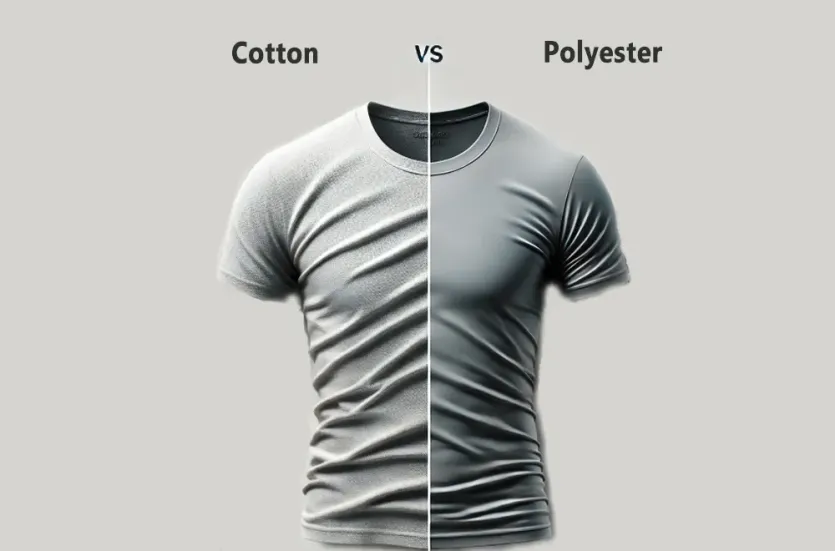
Breathability is an important consideration when developing T-shirts for different climates and activities.
However, breathability is not determined by fiber composition alone.
Fabric weight, yarn structure, knitting construction, porosity, and finishing all influence airflow and comfort.
Cotton Breathability
Cotton fabrics can provide comfortable everyday wear, especially when developed with suitable lightweight or breathable knit constructions.
They are often considered for casual T-shirts, summer clothing, and corporate apparel.
Polyester Breathability
Polyester fabrics can also be highly breathable when designed with suitable knit structures.
Mesh fabrics and engineered polyester constructions are commonly used in sportswear to improve airflow and moisture management.
Which Should You Choose?
For everyday casualwear, cotton can be a practical choice.
For sports and active use, performance-oriented polyester fabrics may be more suitable.
The best approach is to evaluate the actual fabric sample and consider the intended application rather than choosing based only on fiber composition.
6. Cotton vs. Polyester T-Shirts: Which Is Better for Printing?
Printing compatibility is an important consideration for clothing brands and wholesale buyers.
Different fibers respond differently to printing processes, so fabric selection and decoration methods should be planned together.
Printing on Cotton T-Shirts
Cotton is commonly used for:
Screen printing
Direct-to-Garment (DTG) printing
Direct-to-Film (DTF) transfers
These methods can produce different print appearances and hand feels.
For example, DTG is frequently selected for detailed artwork on compatible cotton garments, while screen printing is often considered for suitable bulk orders.
Printing on Polyester T-Shirts
Polyester is commonly used for:
Sublimation printing
Compatible screen-printing systems
Suitable DTF transfer applications
Sublimation printing is particularly popular for polyester sportswear because it allows detailed, multicolor designs.
However, traditional dye sublimation works best with suitable polyester-based materials, generally on light-colored fabrics.
Specialized processes and transfer systems may be needed for other fabric colors or compositions.
What About Cotton-Polyester Blends?
Blended fabrics require additional consideration.
The ratio of cotton to polyester can influence color appearance, ink behavior, and printing performance.
For example, sublimation on cotton-polyester blends may produce less vibrant or less predictable results than on suitable high-polyester fabrics.
Always confirm printing compatibility through sample testing before bulk production.
7. Cotton vs. Polyester: Which Fabric Is Better for Different Applications?
The right fabric depends on the purpose of your T-shirt project.
Corporate and Promotional T-Shirts
Cotton is often considered for company events, team-building apparel, promotional T-shirts, and everyday employee clothing.
It offers a familiar casualwear feel and works with various common printing methods.
Polyester can also be considered when the garments are intended for outdoor activities, sports events, or situations where quick drying is important.
Sports Jerseys and Teamwear
Polyester is widely used for sports jerseys because suitable fabric constructions can provide moisture management, lightweight performance, and compatibility with sublimation printing.
For team uniforms and custom sportswear, buyers should consider fabric construction, breathability, stretch, and print requirements.
Streetwear and Premium Casualwear
Cotton is frequently used for heavyweight T-shirts, oversized styles, and premium casualwear collections.
Fabric weight, yarn quality, knitting structure, and finishing all influence the final appearance and hand feel.
Promotional Sportswear
For promotional sports T-shirts, polyester can be a practical option when the project prioritizes lightweight construction, quick drying, and colorful graphics.
The choice should also consider budget, target customers, and expected garment use.
Everyday Basic T-Shirts
Cotton is a popular option for basic T-shirt collections because of its familiar comfort and versatility.
Cotton-polyester blends can also be considered when buyers want to balance different fabric characteristics.
8. Cotton vs. Polyester vs. Cotton-Polyester Blends
You do not always have to choose between 100% cotton and 100% polyester.
Blended fabrics combine two or more fiber types to achieve a different balance of properties.
Cotton-Polyester Blends
Cotton-polyester blends are commonly used in casualwear, uniforms, and promotional apparel.
Potential benefits include:
A balance of cotton’s familiar hand feel and polyester’s dimensional stability.
Reduced wrinkling compared with some 100% cotton fabrics.
Different combinations of comfort, durability, and care performance.
However, the final result depends on the fiber ratio, yarn construction, knitting structure, and finishing.
How to Choose a Blend Ratio
Common commercial blends include 50/50 and 60/40 cotton-polyester compositions, although many other ratios are available.
The best ratio depends on the product requirements.
For example:
A higher cotton proportion may be preferred when a cotton-like hand feel is important.
A higher polyester proportion may be preferred for selected performance or care requirements.
A balanced blend may suit general promotional and everyday apparel.
These are starting points for product development, not universal performance guarantees.
9. What Should Buyers Consider Before Choosing T-Shirt Fabric?
Before confirming your fabric for bulk production, consider the following factors.
1. Target Customers and Market Positioning
Think about who will wear the T-shirts and how they will be used.
A fashion brand, a corporate buyer, and a sports team may have very different requirements.
2. Fabric GSM and Construction
GSM measures fabric mass per square meter, but it does not independently determine softness, breathability, thickness, or quality.
Consider GSM alongside fiber composition, knit construction, yarn quality, and finishing.
3. Printing and Decoration Requirements
Confirm your logo, artwork, printing method, and garment color before selecting the final fabric.
The printing process should be compatible with the chosen material.
4. Shrinkage and Colorfastness
Ask about fabric shrinkage, dimensional stability, and colorfastness requirements.
Appropriate testing helps evaluate how the fabric performs during washing and use.
5. Budget and Production Requirements
Consider the total garment cost, including fabric, printing, cutting, sewing, finishing, labels, and packaging.
The best fabric is not necessarily the cheapest or the most expensive. It should meet your product requirements and target price.
6. Sample Approval
Request and evaluate an actual fabric and garment sample before bulk production.
Confirm the hand feel, appearance, fit, printing result, and relevant performance requirements before approving the production specifications.
10. Custom T-Shirt Fabric Solutions at ZhuoYu Apparel
Choosing between cotton and polyester is an important step in developing a successful custom T-shirt collection.
At ZhuoYu Apparel, we focus on custom apparel manufacturing, including T-shirts, sports jerseys, sport shorts, and other customized clothing products.
Different projects require different fabric solutions. A corporate T-shirt, a premium streetwear product, and a performance sports shirt may all need different material specifications.
When developing your custom T-shirts, consider:
Cotton, polyester, or blended fabric options.
Fabric GSM and construction.
Custom printing and logo requirements.
Garment fit, colors, and sizes.
Labels, packaging, and other customization details.
Looking for a custom T-shirt manufacturing partner?
Contact ZhuoYu Apparel to discuss your fabric selection, printing requirements, and custom apparel project.
Share your design and product specifications with us to explore a suitable manufacturing solution.
Frequently Asked Questions
Are cotton T-shirts better than polyester T-shirts?
Neither is universally better. Cotton is often preferred for everyday casualwear, while polyester is widely used for sportswear and performance apparel. The right choice depends on the intended use and product requirements.
Which fabric is better for hot weather?
Both cotton and polyester can be suitable for warm weather when properly designed. Lightweight construction, fabric porosity, and moisture management are important factors to consider.
Do polyester T-shirts last longer than cotton T-shirts?
Polyester often offers good dimensional stability and resistance to certain forms of wear. However, the durability of a T-shirt also depends on fiber quality, fabric construction, stitching, finishing, and care.
Does cotton shrink more than polyester?
Cotton can be more prone to shrinkage, particularly when fabric processing and garment care are not properly controlled. Polyester generally offers better dimensional stability, although actual results depend on the fabric and manufacturing process.
Can cotton T-shirts be used for sublimation printing?
Traditional dye sublimation is generally intended for suitable polyester-based fabrics. It is not directly suitable for conventional 100% cotton T-shirts. Other printing techniques, such as screen printing, DTG, and DTF, may be more appropriate for cotton.
Is a cotton-polyester blend good for custom T-shirts?
Yes. Cotton-polyester blends can offer a balance of different fiber characteristics. The best blend ratio depends on the intended application, desired hand feel, printing requirements, and target price.
What is the best GSM for cotton and polyester T-shirts?
There is no single ideal GSM for either fiber. The appropriate fabric weight depends on the garment design, season, fit, intended use, and fabric construction. Always evaluate actual samples before bulk production.
Should I choose the fabric before selecting the printing method?
Fabric and printing should ideally be considered together during product development. Cotton, polyester, and blended fabrics have different printing requirements, so compatibility should be confirmed before bulk production.
Ready to develop your custom T-shirt collection? Contact ZhuoYu Apparel to discuss your fabric, printing, and manufacturing requirements.